
Table of Contents
- The Hype Machine: Why AI is Stealing the Spotlight
- Defining the Difference: Automation vs. AI
- The Reality of the Deskless Workforce
- Why “Simple” Automation Often Outperforms AI
- The Hidden Dangers of Over-Engineering
- When AI is Actually the Right Tool for the Job
- Building a Foundation First
- The Bottom Line: Prioritizing Stability in a Volatile Market
The Hype Machine: Why AI is Stealing the Spotlight
If you look at the current landscape of HR and operations software, it feels like an arms race. Every vendor is rushing to slap an AI badge onto their product. You see promises of predictive scheduling, neural networks that guess who will call out, and machine learning models that allegedly revolutionize how you staff your shifts.
For an operations leader or an HR manager, this creates an intense pressure to innovate. There is a fear that if your systems are not “smart” in the AI sense, you are somehow operating in the past. It is easy to assume that because the technology is complex, it must be the solution to your complex staffing problems.
However, there is a disconnect between the marketing hype and the reality on the shop floor or in the nursing station. Most workforce crises do not stem from a lack of predictive intelligence. They stem from a lack of basic, reliable, and high-velocity communication processes. Before you jump into the world of predictive modeling, it is worth asking if you have actually mastered the art of simple, effective automation.
Defining the Difference: Automation vs. AI
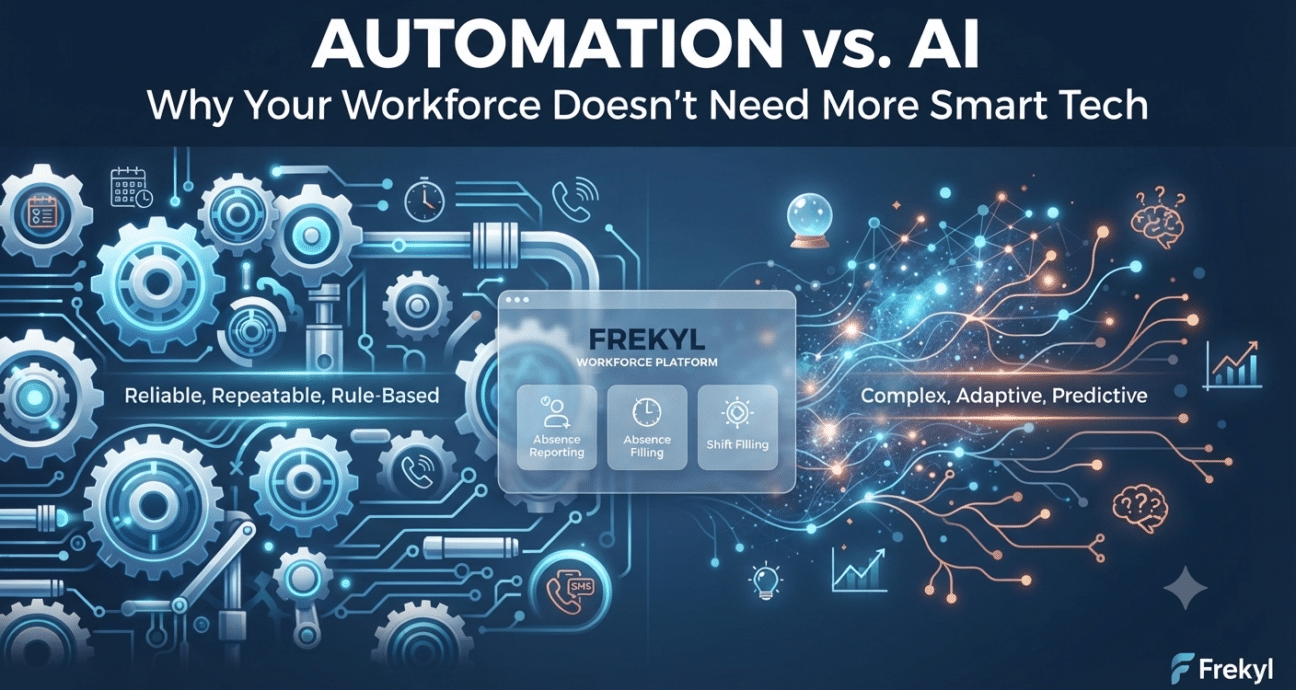
To make better technology investments, we need to strip away the jargon. The debate of Automation vs. AI is often conflated by vendors who want to sell the more expensive option, but they serve fundamentally different functions.
Automation is the art of the rule follower. It is designed to perform repetitive, manual tasks with absolute consistency. You define a set of instructions, and the software executes them every single time. It is predictable, transparent, and incredibly fast. It does not need to learn because it is designed to follow the logic you have already perfected.
AI, by contrast, is the problem solver in a gray area. It is designed to consume vast amounts of data, find hidden patterns, and make probabilistic decisions. It excels in environments where the outcome is not binary and where the variables are constantly shifting in ways that cannot be mapped by simple rules.
Think of it this way. If you want to ensure that a call-out is recorded and the right person is notified within sixty seconds, that is a task for automation. If you want to know what the weather will be like in three years or which marketing campaign will have the highest ROI based on five years of consumer sentiment data, that is a job for AI.
The Reality of the Deskless Workforce
Managing a deskless workforce is a high-stakes, high-velocity endeavor. Whether you are running a manufacturing plant, a logistics hub, or a healthcare facility, your team members are on their feet, not behind a laptop. They are not checking their work email for updates. They are dealing with physical realities that do not wait for software to load or passwords to be reset.
When an employee calls out, the clock starts ticking immediately. A shift left empty is a production line stopped or a patient care ratio jeopardized. In this environment, the “smart” technology often fails because it is too cumbersome.
If you have an AI-driven scheduling system that requires a login, a password, and a complicated app interface, you have already lost. The deskless worker needs to get the message out, and the manager needs to fill the gap before the production delay cascades. The complexity of the “smart” system becomes a barrier to the very agility you are trying to achieve.
Why “Simple” Automation Often Outperforms AI
When we look at the core needs of HR and operations managers, we find that simple automation often provides more value than even the most sophisticated AI. Here is why the Automation vs. AI comparison so often favors the former for operational tasks.
- Reliability is non-negotiable. When you automate a process like absence reporting, you need to know it will work every time. You don’t need a system that “guesses” what an employee wants to do. You need a system that executes the protocol.
- Speed of execution. In a shift-filling scenario, milliseconds matter. Simple automation using SMS or IVR allows an employee to report an absence without needing to learn a new interface. It removes friction from the system.
- Transparency and control. Automation follows your rules. When you launch a shift callout via a tool like Frekyl, you are the one in the driver’s seat. You know who is being contacted, how they are being contacted, and what the criteria are. You do not have to wonder if a black-box algorithm made a strange staffing decision.
For many organizations, the ability to save dozens of hours per week is found not in fancy predictive features, but in the elimination of the manual phone tree. By automating the communication layer, you give your managers the power to fill shifts in minutes rather than hours.
The Hidden Dangers of Over-Engineering
There is a temptation to assume that more technology equals more value. In reality, adding AI to a broken process is like putting a rocket engine on a tricycle. It doesn’t solve the structural problem; it just makes the crash more spectacular.
AI models can experience what engineers call “drift.” They can learn bad habits from biased data. If your AI starts making automated scheduling decisions that inadvertently prioritize certain shifts over others, or if it fails to account for a specific regulatory requirement like AS9100, you are left holding the bag.
Furthermore, AI requires high-quality, clean data to be effective. If your underlying communication processes are messy—if you are still relying on sticky notes, whiteboards, or fragmented spreadsheets—the AI will only amplify the chaos. You have to digitize and automate the process before you can ever hope to optimize it with intelligence.
When AI is Actually the Right Tool for the Job
This is not to say that AI is inherently bad or useless. It is an incredibly powerful tool when applied to the right problems. If your challenge is identifying patterns in massive datasets that a human could never process, AI is your best friend.
AI is excellent for:
- Complex Forecasting: Looking at historical absenteeism rates across five years and ten different sites to predict seasonal surges.
- Sentiment Analysis: Reading through thousands of employee feedback survey responses to identify underlying cultural issues.
- Resource Optimization: Analyzing supply chain variables that are too complex for a standard rule-based system to handle.
If your problem is “I have too much data and not enough insight,” then by all means, bring in the AI. But if your problem is “I cannot fill a shift fast enough when someone calls out,” don’t let a salesperson convince you that a neural network is the solution.
Building a Foundation First
The most successful operations leaders we work with are the ones who focus on their foundation. They ensure that their basic communication channels are solid. They ensure that when a worker needs to report an absence, they can do so instantly via SMS or IVR.
They realize that if they can shave ten minutes off the time it takes to fill a shift, they have created immediate, tangible value for the organization. This isn’t about being fancy. It is about being effective.
Once you have that foundation—once your shift-filling process is automated and reliable—that is when you have the data and the stability to start exploring AI. You can then use AI to look at that clean, automated data to make better decisions. You cannot skip the step of building a reliable system.
The Bottom Line: Prioritizing Stability in a Volatile Market
We live in an era where operations leaders are under immense pressure to deliver more with less. The “zero-buffer” reality of modern manufacturing and logistics means that there is no margin for error.
When you are deciding between Automation vs. AI, ask yourself what problem you are actually trying to solve today. Are you trying to predict the future, or are you trying to keep the production line moving right now?
The best technology is the one that disappears into the background, enabling your team to work faster and with less stress. For the vast majority of operations, that technology is simple, robust, and highly reliable automation. Don’t let the promise of “smart” tech lead you to ignore the massive benefits of a well-oiled, automated process.
Focus on the foundation. Ensure your team has the tools to communicate instantly, and the rest of your operations will become significantly easier to manage. After all, the best way to prepare for the future is to master the present.